
Your support queue does not speak one language, and neither do your clients. Forex brokers operating across Southeast Asia face a daily reality that many software vendors do not design for: clients switching between Bahasa Malaysia, Thai, Vietnamese, Simplified Chinese, Traditional Chinese, Arabic, English, and mixed-language messages, sometimes within a single conversation.
When your team cannot respond accurately and quickly in a client’s preferred language, trust can drop. In forex support, this matters because many client questions involve deposits, withdrawals, KYC status, account access, margin, leverage, or trading platform issues.
This is why multilingual AI support for forex brokers is no longer only a convenience. For brokerages serious about growth in Southeast Asia and other multilingual markets, it is becoming an operational requirement.
Why Language Barriers Are Costing SEA Forex Brokers Clients
Southeast Asia is a multilingual market. A broker based in Kuala Lumpur may support clients from Malaysia, Thailand, Indonesia, Vietnam, mainland China, Hong Kong, Taiwan, the Middle East, and other regions at the same time.
Traditional translation tools create a dangerous gap in forex customer service. Word-for-word translations may fail to preserve the precise meaning of financial terms like margin call, lot size, leverage ratio, KYC status, withdrawal review, or IB commission.
A client who receives an inaccurate explanation about their account status or trading condition may become confused, frustrated, or worried. For the brokerage, this can lead to longer handling time, repeated follow-ups, unnecessary escalation, and weaker client trust.
The hidden cost of language gaps is not only translation error. It is repeated clarification, slower support resolution, higher agent workload, and clients feeling that the brokerage does not understand them.
What Makes AI-Powered Multilingual Support Different for Forex
An AI Customer Service or AI Agent built for forex broker customer support does not simply translate text. It understands the client’s intent, the brokerage’s approved knowledge base, and the financial meaning behind the question.
This distinction matters because a forex client may ask a simple-sounding question that has several possible financial meanings.
For example:
- “Why did my money go down?” could mean trading loss, swap charge, fee deduction, margin movement, bonus adjustment, or withdrawal deduction.
- “Why is my account blocked?” could mean KYC review, compliance hold, failed login attempts, restricted trading access, or pending document verification.
- “Why can’t I withdraw?” could mean incomplete KYC, payment method mismatch, pending trade settlement, bonus rule restriction, or manual review.
A multilingual AI Customer Service is designed to preserve this meaning across languages instead of giving a simple literal translation.
For forex brokers, AI-powered multilingual support can help by:
- Responding in the client’s preferred language automatically across scripts such as Latin, Thai, Chinese, Arabic, Cyrillic, and more.
- Preserving forex-specific terminology across languages so financial meaning stays accurate.
- Understanding client intent instead of only translating the literal words.
- Operating 24/7 across the time zones where your clients are active.
- Handling repetitive FAQ volume so human agents can focus on complex, sensitive, or high-value cases.
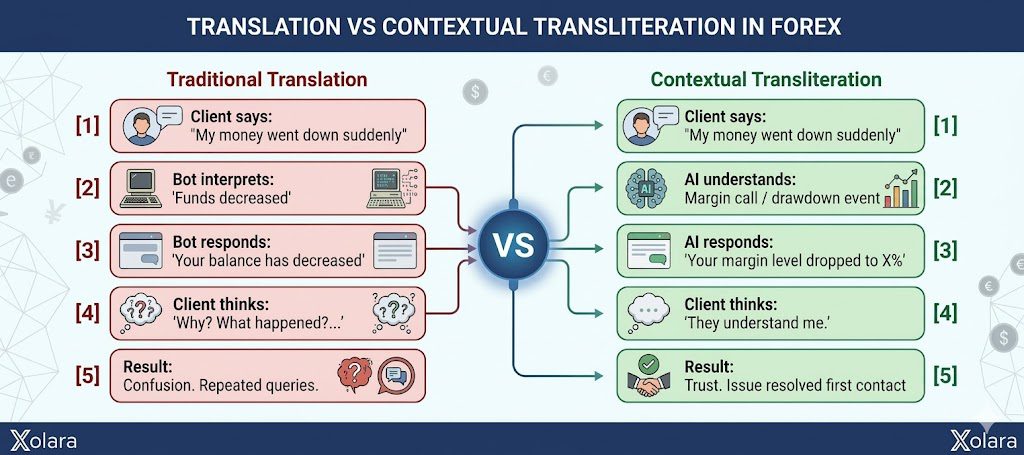
Traditional translation focuses on words. AI-powered multilingual support focuses on client intent, financial context, and broker-approved response accuracy.
In simple terms, this is not just translation. It is multilingual support with financial context.
Learn how our AI Customer Service handles forex client queries →The Real Cost of Scaling a Human Multilingual Support Team
The conventional solution to multilingual forex client support is to hire more people: Thai-speaking agents for Thai clients, Mandarin-speaking agents for Chinese clients, Vietnamese-speaking agents for Vietnamese clients, Bahasa-speaking agents for Malaysia and Indonesia, and Arabic-speaking agents for Middle Eastern clients.
This approach can work at the beginning, but it becomes expensive and difficult to scale. Headcount grows with each market. Training becomes harder. Quality control becomes more complex. During trading volatility or payment delays, the queue can still overwhelm the team.
An AI Customer Service for forex broker operations helps reduce this pressure by handling repetitive multilingual enquiries in parallel. Human agents are then free to handle cases that require judgment, empathy, account access, escalation, or VIP relationship management.
Explore the full Xolara AI Customer Service feature set to see how multilingual support fits into the broader support automation stack.
For Operations Managers and COOs, this changes the budget conversation from “how many more support staff do we need to hire?” to “how do we use our existing team for higher-value support work?”
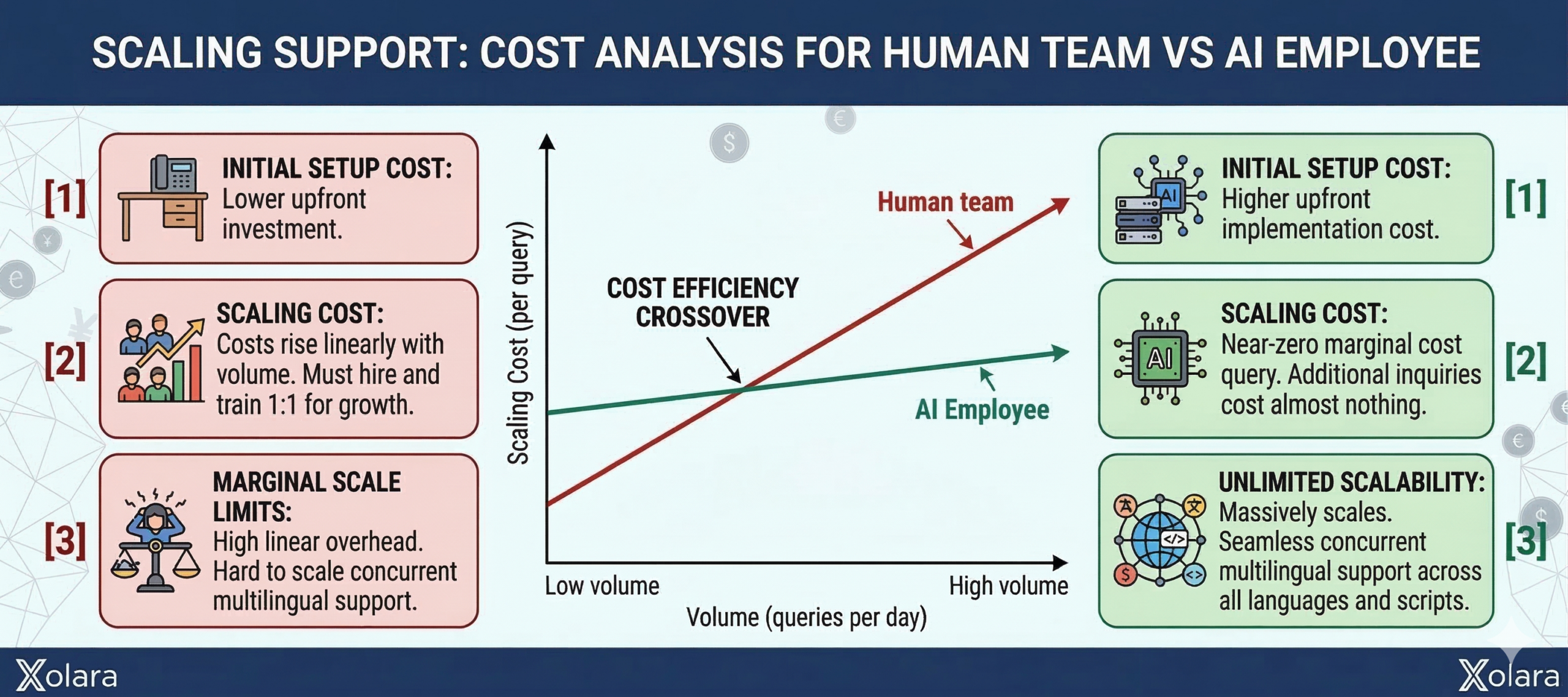
Scaling multilingual support only through headcount can become expensive. AI support automation helps absorb repetitive multilingual enquiries.
How Seamless Human Escalation Protects Client Trust
AI should not handle every situation alone. Forex clients dealing with delayed withdrawals, KYC issues, restricted accounts, VIP complaints, or sensitive financial concerns may still need human support.
The important part is how the AI hands over the conversation. If a client explains their issue to the AI, gets transferred to a human agent, and then needs to explain everything again, the support experience feels broken.
A proper AI Customer Service treats handover as a continuation, not a reset. Before escalation, the AI can:
- Collect relevant client information before transferring the case.
- Prepare a concise summary of the issue and conversation history.
- Transfer the full context to the human agent in real time.
- Include the client’s language preference so the right agent can continue the conversation.
- Reduce repeated questions and help the agent respond faster.
When human agents take over with full context, they can start resolving the issue immediately. This can reduce average handling time and improve the client experience.
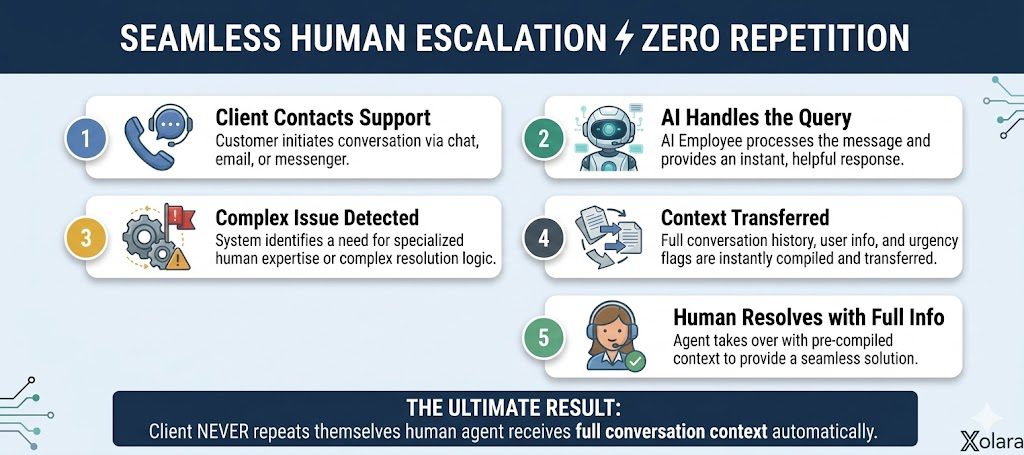
Seamless escalation allows the AI to pass client details, issue summary, language preference, and conversation history to the human agent.
See how seamless escalation works in practice →What SEA Forex Brokers Should Look for in an AI Agent Partner
Not all AI customer service platforms are suitable for forex broker support. When evaluating an AI agent solution for your brokerage, look beyond the chatbot demo and focus on whether the system can support real brokerage operations.
Important evaluation criteria include:
- Forex-specific language understanding — the AI should understand margin call, IB commission, swap-free account, leverage, lot size, withdrawal review, and KYC across languages.
- Script coverage — the AI should handle Thai, Chinese, Arabic, Latin-script languages, and other relevant scripts without major accuracy loss.
- Customisable deployment — the system should fit your existing support workflow, not force your team to change around a rigid template.
- Human escalation quality — the handover to your live agents should include summary, urgency, language preference, and conversation context.
- CRM and helpdesk readiness — the provider should have a clear path for integration with your CRM, Zendesk, Freshchat, internal ticketing system, or brokerage backend.
- Performance during spikes — the AI should support high-volume periods during market volatility, payment delays, or major announcements.
These criteria separate a generic chatbot from a true AI Customer Service built for the operational demands of a forex brokerage.
See our AI Customer Service evaluation checklist for forex brokers →Frequently Asked Questions
What is multilingual AI support for forex brokers?
Multilingual AI support for forex brokers is an AI-powered support system that can understand and respond to client enquiries across multiple languages while preserving financial meaning for brokerage-specific topics such as deposits, withdrawals, KYC, leverage, margin, and trading accounts.
Why do forex brokers need multilingual AI support?
Forex brokers often serve clients across different countries and languages. Multilingual AI support helps brokerages respond faster, reduce repetitive workload, support more markets, and maintain consistent answers across different client languages.
Is multilingual AI support the same as using Google Translate?
No. Translation tools mainly convert words from one language to another. A forex-focused AI Customer Service should understand the client’s financial intent, broker policies, support workflow, and escalation rules before responding.
Can AI handle mixed-language forex client messages?
Yes, a well-designed AI Customer Service can handle mixed-language messages where clients combine English, Bahasa Malaysia, Chinese, Thai, Vietnamese, or other languages in the same conversation. The AI should identify the intent and respond clearly in the client’s preferred language.
Can multilingual AI support escalate to a human agent?
Yes. When a query is sensitive, complex, or requires human judgment, the AI can escalate the conversation to a human agent with client details, issue summary, urgency level, preferred language, and conversation history.
Conclusion
Multilingual AI support for forex brokers is becoming an important part of modern brokerage operations. It helps support teams respond across languages, preserve financial meaning, reduce repetitive workload, and escalate sensitive cases with full context.
For brokerages operating in Southeast Asia, multilingual support is not only about convenience. It directly affects client trust, response speed, agent workload, and the ability to scale into new markets.
Read our frequently asked questions or explore what an AI Customer Service is and why forex brokers need one to learn more.