
When evaluating an AI Customer Service or AI Agent for a forex brokerage, the most important criteria are not only price or interface design. You need to check whether the AI can handle forex-specific language, multilingual conversations, sensitive escalation, support spikes, internal workflow customisation, and client data responsibly.
Most AI customer service platforms were not built for the forex industry. Fewer still were built for the multilingual, high-volume reality of operating a forex brokerage across Southeast Asia. A generic demo may look impressive, but it will not always reveal the gaps that matter most to your support team.
These 10 questions are designed to help you evaluate vendors more clearly. You can use them in vendor meetings, internal reviews, procurement discussions, or side-by-side comparisons.
AI Customer Service vs Generic Chatbot: The Core Difference
Before using the checklist, it is important to understand the difference between an AI Customer Service and a generic chatbot because vendors often blur this distinction.
- Generic chatbot: usually matches keywords to fixed answers. It may work for simple and predictable questions, but it often struggles with financial nuance, multilingual accuracy, and complex client intent.
- AI Customer Service or AI Agent: understands the financial intent behind a client message, responds with contextual accuracy, supports multiple languages, and escalates cases to human agents when judgment is needed.
This checklist helps reveal which category a vendor actually belongs to, regardless of how they market their product.
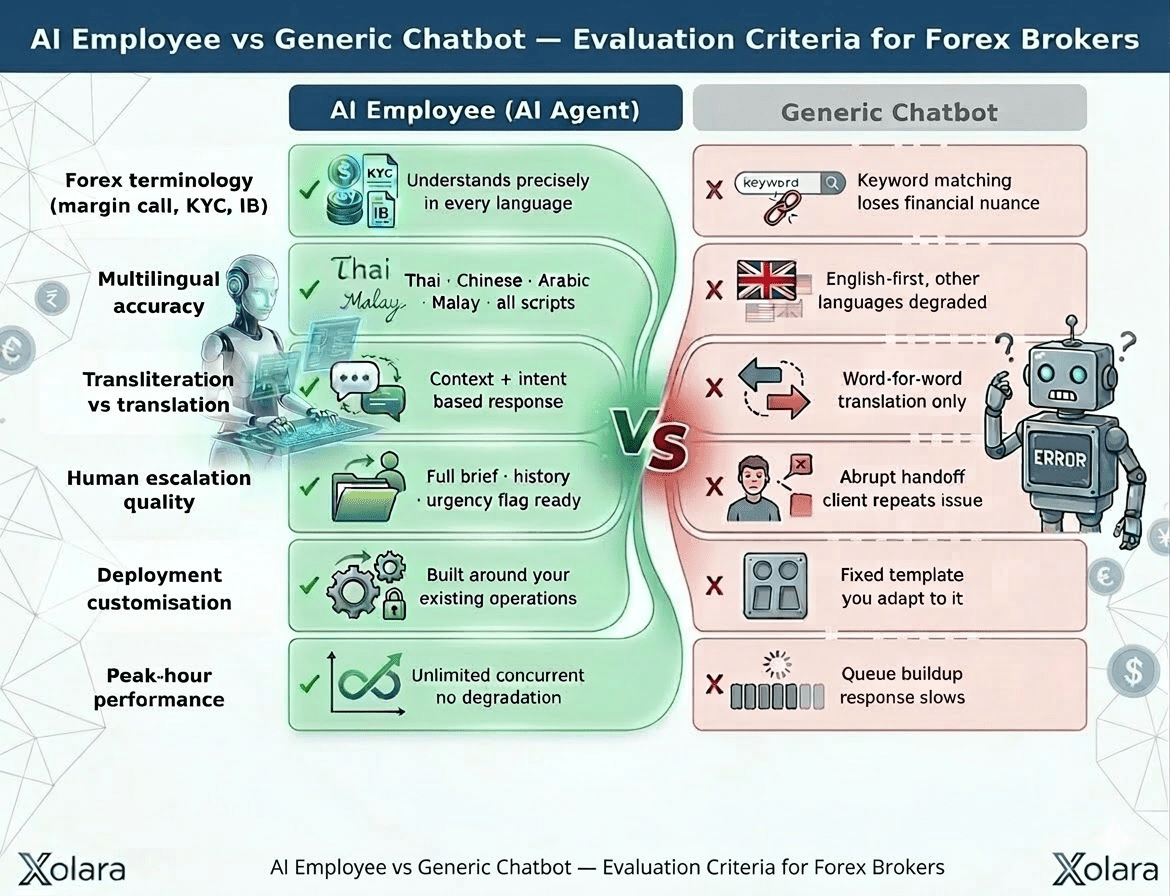
AI Customer Service versus generic chatbot — key evaluation criteria for Southeast Asian forex brokers.
The 10-Question Evaluation Checklist
1. Does it understand forex-specific terminology in every language it supports?
A forex AI must accurately handle terms like margin call, lot size, leverage ratio, swap-free account, KYC status, withdrawal review, deposit confirmation, trading account, spread, and IB commission. It should not only understand these terms in English, but also in the languages your clients actually use.
Show me how the AI handles a margin call question in Thai. Show me how it explains KYC document requirements in Simplified Chinese.
Red flag
The vendor only demonstrates English responses, or the non-English responses feel unnatural, inaccurate, or too generic to a native speaker.
2. Is it contextual translation or word-for-word translation?
Contextual translation preserves the meaning of a financial message in the client’s language. Word-for-word translation may preserve the words but lose the actual intent. This is risky in a financial environment where precision matters.
For example, if a client says their balance is lower than expected, the AI should understand that this could relate to trading loss, fees, swap, margin movement, bonus adjustment, withdrawal deduction, or account activity. It should not treat the question as a simple display issue without checking the context.
We explain this in more detail in our guide to multilingual AI support for forex brokers.
If a client writes “why is my balance lower than expected?” in Vietnamese, what does the AI interpret that as, and how does it respond?
Red flag
The AI gives a generic balance explanation without considering margin, trading loss, fees, swap, deposit bonus rules, or account-specific escalation.
3. Which languages and scripts does it support without degraded accuracy?
For Southeast Asian forex brokers, language support is not just about English and Chinese. Many brokerages need support for Thai, Vietnamese, Bahasa Malaysia, Bahasa Indonesia, Arabic, Simplified Chinese, Traditional Chinese, and sometimes Cyrillic or Devanagari scripts.
The important question is not only whether the AI can reply in those languages. The important question is whether quality remains consistent across different scripts, informal phrasing, mixed-language messages, and finance-related terminology.
Demonstrate Thai, Vietnamese, Chinese, and Arabic support in the same session. Test informal client-style messages, not only clean formal sentences.
Red flag
The vendor avoids specific scripts, cannot show live examples, or response quality is noticeably weaker outside English or Chinese.
4. How does escalation to human agents actually work?
Seamless escalation means the human agent receives a useful handover before responding. This should include the client issue, conversation summary, relevant details, urgency level, and full conversation history.
The client should not need to repeat the same explanation again after escalation. If the escalation process only sends a raw transcript with no summary or context, the system is not ready for serious brokerage operations.
Read our detailed breakdown of how seamless AI-to-human escalation works for forex brokers.
Walk me through an escalation scenario from start to finish. What exactly does my human agent see when they receive the conversation?
Red flag
The escalation only passes a transcript with no summary, no urgency flag, no recommended next step, and no clear handover structure.
5. Can it be customised to your existing operations flow?
Your brokerage has its own escalation rules, compliance language, client segmentation, internal policies, approval workflow, and support team structure. An AI system that forces your brokerage to change operations around its template can create adoption problems.
A suitable AI Customer Service should be configurable around your existing support process, not the other way around.
How is the system configured for our specific workflows? What is fixed, what is customisable, and who controls the configuration after deployment?
Red flag
The vendor only offers a standard setup with limited flexibility, or every workflow change requires long engineering lead time.
6. How does it perform during peak trading hours?
Forex support volume can spike sharply during market volatility, central bank announcements, non-farm payroll releases, geopolitical events, payment delays, or platform interruptions.
At exactly those moments, your AI system should absorb support volume instead of slowing down, queuing clients, or creating additional pressure for your human agents.
What is the maximum concurrent conversation capacity? What happens when ticket volume suddenly increases during a market event?
Red flag
The vendor cannot explain capacity, latency, fallback handling, queue behaviour, or high-volume support performance.
7. What does the deployment timeline look like?
An AI platform that takes too long to deploy can create more burden for your team instead of reducing workload. A good vendor should clearly explain the implementation stages, what your team needs to provide, and what the vendor will configure.
From contract signing to live deployment, what is the realistic timeline? What documents, access, system information, or support workflows do we need to provide?
Red flag
The timeline is unclear, depends heavily on your internal IT team, or pushes full functionality several months into the future.
8. What is the provider’s product roadmap for the next 12 to 24 months?
The most valuable AI Customer Service providers are not only building chat automation. They are moving toward deeper operational automation, including CRM integration, real-time withdrawal status lookup, KYC progress retrieval, deposit confirmation, support analytics, and workflow automation.
A provider with no clear roadmap may be a short-term chatbot vendor, not a long-term technology partner. See Xolara’s feature set for an example of what to evaluate.
What does your product roadmap look like over the next 12 to 24 months? What integrations and automation features are planned?
Red flag
The vendor gives vague answers about upcoming features, has no clear integration roadmap, or cannot explain future broker-specific capabilities.
9. How is client data handled and what are the compliance implications?
Any AI system processing forex client conversations may handle sensitive operational, financial, and account-related information. Data storage, access control, encryption, retention, auditability, and vendor responsibility should be clearly documented.
This is especially important when your clients are located across different countries, and when your brokerage has internal compliance requirements.
Where is client conversation data stored? Who can access it? What is the retention policy? Can the provider document its data handling process?
Red flag
The vendor gives vague answers, avoids written documentation, or cannot clearly explain data storage, access control, or retention policies.
10. Can the provider share relevant client references or deployment proof?
A live reference or deployment example is stronger than a sales claim. Ideally, the provider should be able to explain real deployment scenarios, operational results, support use cases, and lessons learned from similar clients.
For forex brokers, references from similar financial support environments are more valuable than references from unrelated industries.
Can you share a relevant deployment example, case study, or client reference from a forex, crypto, financial services, or high-volume support environment?
Red flag
The vendor has no relevant deployment examples, only generic testimonials, or references from businesses that do not resemble your support environment.
How to Score Your Evaluation
After asking these 10 questions, score each answer using a simple 0 to 2 point system.
| Score | Criteria |
|---|---|
| 2 points | The vendor answered specifically and supported the answer with a live demonstration, documentation, or clear deployment example. |
| 1 point | The vendor answered the question, but the answer lacked proof, demonstration, or operational detail. |
| 0 points | The vendor could not answer, gave a vague response, avoided the question, or provided an answer that does not fit forex broker operations. |
A vendor scoring 16 or above out of 20 is worth advancing to a formal proposal stage. A vendor scoring below 12 should be reconsidered regardless of pricing. A vendor that scores 0 on questions 1, 2, 3, or 4 may not be suitable for a multilingual forex brokerage support environment.
Frequently Asked Questions
What is the most important factor when choosing an AI agent for a forex broker?
The most important factor is forex-specific multilingual accuracy. The AI must understand financial terms such as margin call, KYC, leverage, lot size, deposit status, withdrawal review, and IB commission across the languages your clients use.
What is the difference between an AI Customer Service and a chatbot for forex brokers?
An AI Customer Service understands financial intent, conversation context, multilingual client messages, and escalation rules. A generic chatbot usually follows keyword matching or fixed scripts, which may not be enough for complex brokerage support.
How long does it take to deploy an AI Customer Service for a forex brokerage?
The deployment timeline depends on the number of channels, knowledge sources, languages, integrations, and escalation workflows. A standard deployment should have a clear onboarding process, defined responsibilities, and measurable milestones.
Should a forex broker choose a generic AI chatbot or a specialised AI support agent?
A specialised AI support agent is usually more suitable for forex brokers because the support environment involves financial terminology, multilingual conversations, sensitive escalation, CRM data, payment questions, and client trust.
Can an AI Customer Service replace human support agents?
An AI Customer Service should not replace every human support function. The best setup is to let AI handle repetitive and predictable enquiries while human agents focus on VIP clients, complex cases, compliance-sensitive issues, and disputes.